Some links in this post are affiliate links. If you buy something through one, Naturally Well Today may earn a small commission, and the price you pay does not change. How this works.
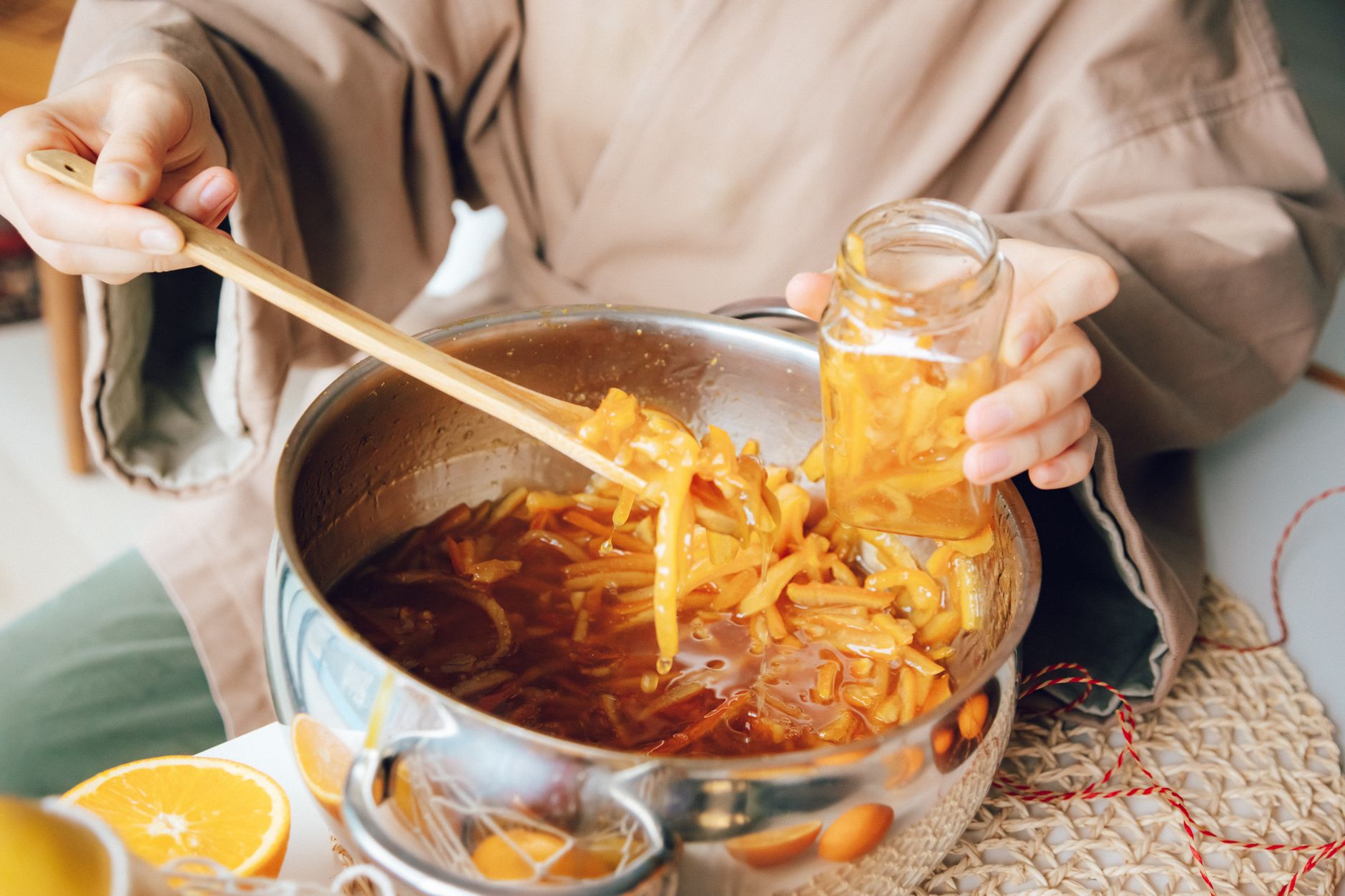
I started saving citrus peels in a jar of vinegar mostly because I disliked the sharp smell of plain white vinegar on countertops, and it seemed wasteful to throw away the peels from oranges we were eating anyway. The idea is simple enough. The oils in the peel, especially the outer colored layer called the zest, infuse slowly into the vinegar and soften that harsh smell into something closer to citrus with a vinegar edge underneath, rather than vinegar alone.
The method I settled on is to fill a clean glass jar about halfway with peels, mostly orange and lemon since that is what we have most often, then pour distilled white vinegar over them until the peels are fully covered, leaving about an inch of space at the top. I cap it and set it in a cabinet out of direct light for two weeks, giving it a shake every few days. After two weeks I strain out the peels through a fine mesh strainer, and what is left is the infused vinegar, ready to dilute.
Getting the dilution right
Straight infused vinegar is too strong and too acidic to use directly on most surfaces, so I dilute it roughly half and half with water in a spray bottle. For a sixteen ounce bottle, that comes out to about eight ounces of the infused vinegar and eight ounces of water. The first time I made this, I used the vinegar undiluted because I was impatient, and it left a slightly hazy film on our kitchen table that took a second wipe with plain water to clear. Diluting it fixed that completely.
I use this mostly on countertops, the outside of appliances, and glass, wiped on and then followed with a dry cloth. It is a mild, everyday cleaner, and I want to be clear about what it is not. It is not a disinfectant in the sense that word gets used for cleaning products meant to kill specific germs, and I do not treat it as one. For cutting boards after raw meat, or anywhere a stronger and more targeted approach is called for, I use a dedicated product made for that purpose rather than this spray. This is for everyday tidying, not for situations where a real sanitizing step matters.
What I learned from a failed batch
One batch grew a thin white film on the surface of the vinegar after about a week, which I later understood happens more often when a bit of pulp or juice gets into the jar along with the peel, giving something for that film to grow on. I tossed that batch rather than second-guess it, cleaned the jar thoroughly, and started over being more careful to use dry peels with as little of the white pith and juice attached as possible. Since then it has not happened again. If you ever see anything like that in your own jar, the safest and simplest choice is to discard the batch and start fresh rather than try to salvage it.
The infusion is patient work. Two weeks feels long when you first start the jar, and then it is suddenly done.
Peel selection matters more than I expected
Peels from citrus that has been sprayed or waxed for shine, which is common with store-bought fruit, still work fine for this because the fragrant oils sit in the zest and the vinegar itself is doing the cleaning work, not the wax. That said, I do give the fruit a good rinse before peeling, mostly out of habit. Lime peel gives a sharper, greener scent than orange, and grapefruit peel is milder than I expected, almost soft in comparison. Mixing two or three types in one jar gives a rounder scent than any single fruit on its own, which is the combination I use most now, usually orange with a smaller amount of lime.
How long a finished bottle lasts
Once diluted and in a spray bottle, I use a batch within about a month, kept out of direct sunlight, which seems to keep the scent from fading too quickly. The undiluted, strained vinegar itself keeps much longer in a sealed jar, closer to several months, since vinegar is naturally quite stable on its own. I just do not dilute more than I plan to use in the near term.
This is a small, low-cost thing to make, and the biggest adjustment for me was patience. It is tempting to strain the peels out early, at three or four days, but the scent at that point is thin and mostly still vinegar. Waiting the full two weeks is what makes the difference between a cleaner that smells like an afterthought and one that actually smells like citrus first.
Labeling and keeping track of batches
I started writing the start date on a strip of masking tape on the jar lid after losing track of how long a batch had been steeping more than once. It sounds like an unnecessary step until you have three jars going at once, one nearly ready and two just started, and no way to tell them apart at a glance. Now every jar gets a date, and once it is strained and diluted into a spray bottle, that bottle gets a date too, so I know when to stop using it and start a new batch rather than guessing.
I also keep the infused vinegar and the diluted spray in different containers entirely, a plain glass jar for the concentrate and a spray bottle for the ready-to-use mixture, so there is never a chance of grabbing the strong, undiluted version by mistake and spraying it directly on a countertop.
Where this fits into an ordinary week
Realistically, this cleaner has become the thing I reach for most days, wiping down counters after cooking, going over the stovetop once the initial mess is dealt with by hand, and cleaning the glass on the front door where fingerprints show up constantly. It is not a specialty product for a specialty job. It is closer to a plain, everyday habit, something that lives under the sink in a bottle that gets refilled every few weeks rather than something I think about much at all.
The jar of peels steeping in the cabinet is a slower, quieter part of the process, more like a small ongoing project than a chore. I usually start a new jar as soon as I strain the last one, so there is always one steeping while another is in use, and it has become one of those small kitchen rhythms that just runs in the background without needing much attention from me.